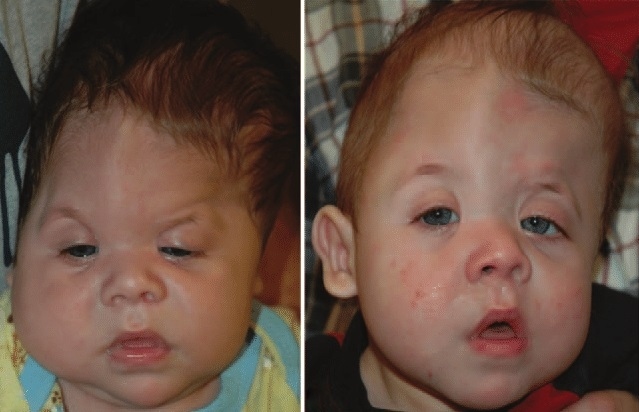
Signs & Symptoms
- Flattened forehead on one side
- Raised eye socket (orbital rim) on the affected side
- Nose deviated toward the opposite side
- Misaligned ears or eyebrows
- Uneven head or facial shape
- In some cases, delayed motor development or vision issues
Expected Outcomes
With early and expert intervention, most children achieve excellent cosmetic and functional results. Ongoing developmental monitoring ensures any related issues are addressed promptly.
Causes & Diagnosis
Unicoronal synostosis is usually nonsyndromic, meaning it occurs on its own. However, genetic syndromes like Crouzon or Saethre-Chotzen may also include this condition.
Diagnosis involves
- Physical examination of head shape and facial symmetry
- CT scan with 3D reconstruction to confirm suture fusion
- Genetic evaluation, if a syndromic cause is suspected
Why Choose Us
for Unicoronal Synostosis Care?
- Multidisciplinary team of craniofacial surgeons, pediatric neurosurgeons, and geneticists
- Advanced diagnostic imaging and surgical planning tools
- Minimally invasive and open surgical options
- Family-focused care and long-term follow-up
Treatment depends on the Type and Severity
Cranial Vault Remodeling Surgery
Surgical correction is typically recommended between 6 to 12 months of age, while the bones are still malleable. The goal is to :
- Reshape the skull and eye socket
- Restore facial symmetry
- Prevent increased intracranial pressure
Endoscopic Surgery
(Minimally Invasive)
In selected early cases (before 6 months), endoscopic-assisted surgery followed by helmet therapy may be an option.